Will You Notice When It Arrives?
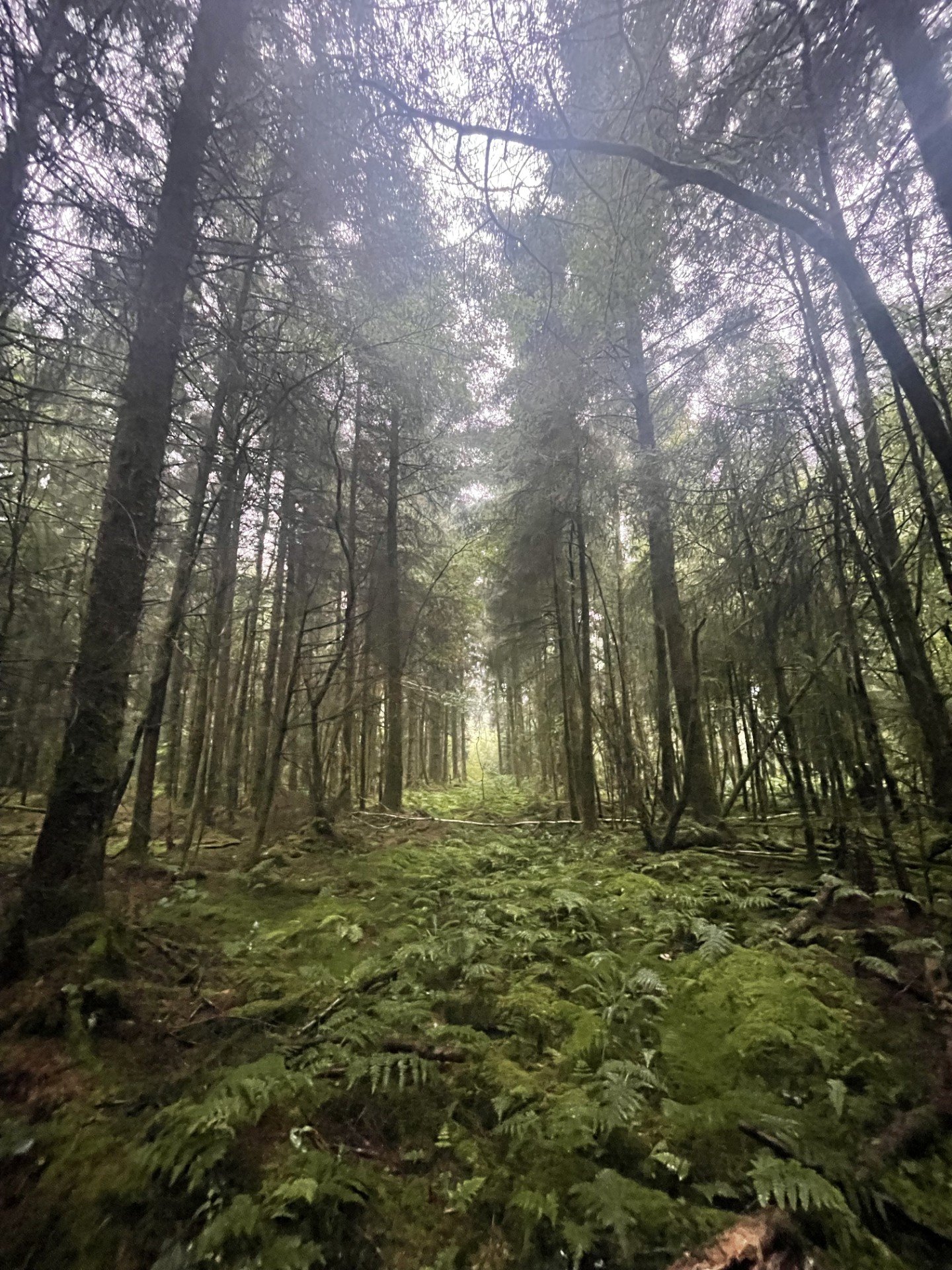
I didn’t expect anything from an ordinary walk through the forest. Then I looked up. What followed was a quiet moment of realising that perhaps all the reflecting, healing, and difficult choices had brought me somewhere I hadn’t noticed I had arrived.
We spend a lot of time looking for evidence that we’re growing. That all the reflecting, learning, struggling and healing is leading somewhere. The trouble is, personal growth rarely arrives with an announcement. We can spend years working on ourselves, trying to understand who we are, what we need and what might make life feel a little easier, without necessarily noticing that anything is changing.
Growth doesn’t always feel like growth
We can spend so much time waiting for that moment when everything suddenly makes sense. When we feel different. When we know we’ve changed. We might imagine it as some big breakthrough, a moment of clarity where everything falls into place and we finally realise that all the work we’ve been doing has paid off.
But I don’t think it always happens like that.
I was out walking in the forest recently. It wasn’t a particularly significant day, and I wasn’t out there looking for anything. I was just walking, thinking about whatever was going through my head, when suddenly I had the thought to look up.
So I did.
I looked up at the trees, at the branches stretching above me and the light coming through the leaves. And for some reason, in that very ordinary moment, I felt something I hadn’t realised I had been missing.
Peace.
The quiet moments matter
It wasn’t dramatic. Nothing had changed around me. There wasn’t some huge revelation or a sudden answer to all of life’s questions. I just stood there and realised that, actually, things were better than they had been in a long time. I felt good. I felt happy. I felt at peace.
And that feeling of peace was almost strange because it wasn’t something I was used to. I had spent a lot of time thinking about what I needed to change, what I needed to understand, what decisions I needed to make and where I wanted my life to go. I had spent time reflecting, working on myself and trying to make choices that felt right for me.
I suppose I had been so focused on getting somewhere that I hadn’t noticed I had already arrived somewhere different.
That moment in the forest didn’t happen because I had suddenly figured everything out. It was the result of lots of small things that had happened along the way. Some difficult, some uncomfortable, some that probably didn’t feel like progress at the time.
That’s often what self-reflection and emotional wellbeing look like. They’re not always obvious. Growth can happen quietly while we’re busy living our lives. We don’t necessarily feel ourselves changing. We just keep making choices, learning about ourselves, questioning things, getting things wrong, trying again and slowly becoming more comfortable with who we are.
How do we know we’ve changed?
And then, every now and again, something makes us stop.
For me, it was looking up at the trees.
It made me wonder how often we miss those moments because we’re too busy looking for the next thing that needs fixing. How often are we so focused on where we want to be that we don’t stop to notice where we actually are?
Perhaps self-awareness isn’t always about finding another thing to work on. Perhaps sometimes it’s about noticing what is already there.
The peace. The confidence. The sense that something feels different. The small decisions that have slowly brought us somewhere new.
Maybe we don’t always need to be searching for evidence that we’re getting somewhere. Maybe sometimes we need to pause long enough to notice that we already are.
So, when was the last time you stopped and looked up?
Living with ADHD: How Counselling Can Help You Understand Yourself
ADHD, Self-Understanding, and the Value of Being Heard
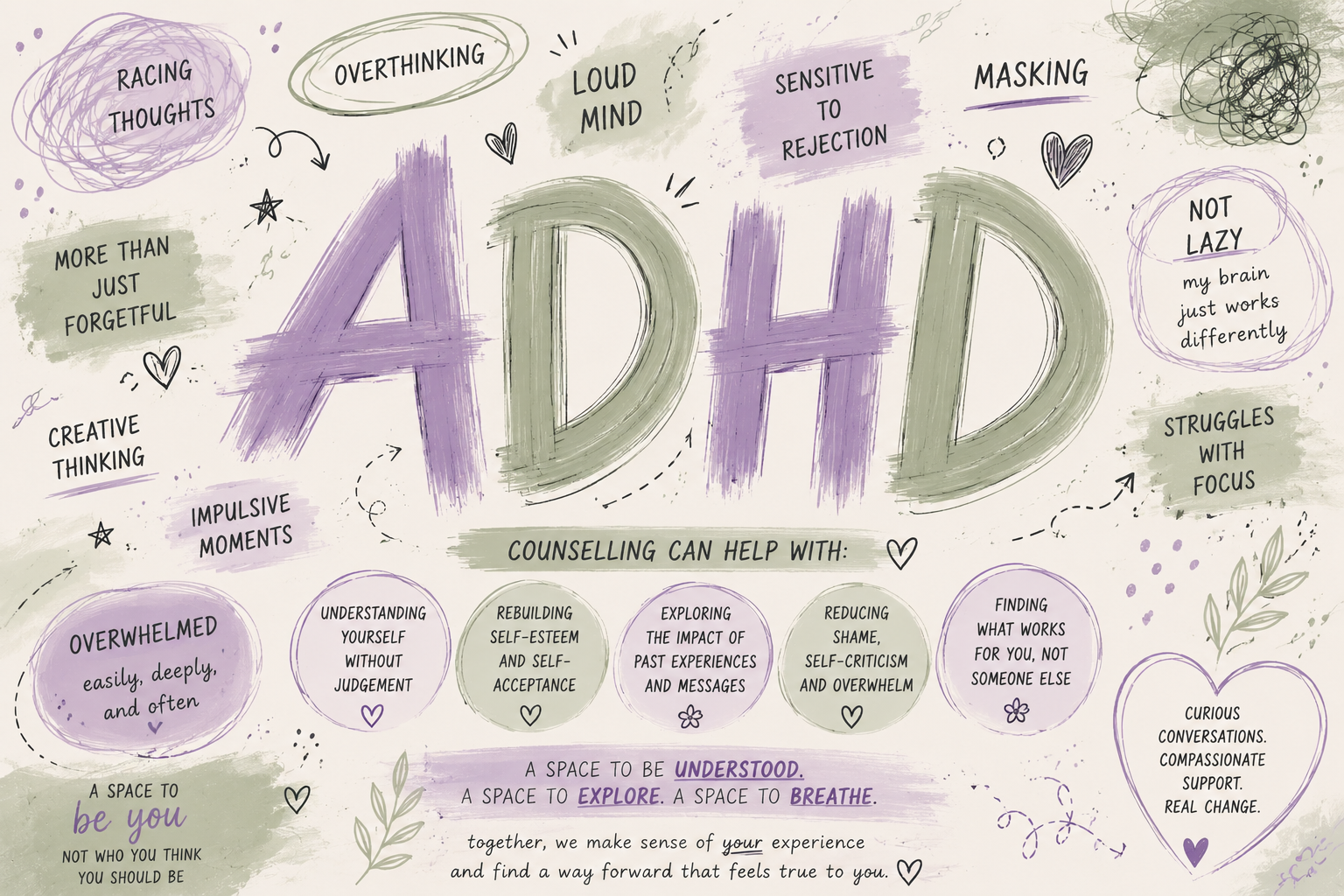
Whether you have a diagnosis of ADHD, are currently seeking an assessment, or simply recognise some of the traits in yourself, living with ADHD can often feel exhausting. While ADHD is commonly associated with attention, focus, and organisation, many people I meet describe something much deeper: years of feeling misunderstood, criticised, overwhelmed, or as though they are somehow falling short of expectations.
As a counsellor, I have a particular interest in working with neurodiversity. Through both my clinical work and my studies in counselling, mental health, and mental health in society, I have become increasingly aware of how limited our understanding of neurodivergence can sometimes be. Although awareness of ADHD has grown significantly in recent years, conversations often focus on behaviours and symptoms while overlooking the lived experience of the person.
In my work, I am less interested in labels than I am in understanding the individual sitting in front of me. Whether ADHD forms part of your story or not, I believe every person’s experience deserves to be met with curiosity, compassion, and respect.
Many people who identify with ADHD have spent years adapting to environments that have misunderstood them. They may have learned to mask aspects of themselves, work harder to meet expectations, or carry a sense that they are somehow failing at things that appear effortless for others. Over time, these experiences can shape how a person understands themselves and their place in the world.
My interest in neurodiversity is closely connected to my interest in mental health within society. I am often curious about the ways we come to understand difference. Sometimes what is described as an individual difficulty may also reflect the expectations, systems, and environments we live within. Educational settings, workplaces, and wider social values often reward particular ways of thinking, learning, communicating, and being. For those whose experiences fall outside these expectations, the impact can extend far beyond practical challenges and into questions of self-worth, belonging, and identity.
As a humanistic and existential counsellor, I do not see therapy as a process of fixing people. Instead, I see counselling as a space where we can make sense of your experiences together. I am interested in understanding how you have come to view yourself, what meaning you have made from your experiences, and whether the stories you carry about yourself are truly your own.
One of the things I value most as a counsellor is creating a space where these experiences can be explored openly and honestly. A space where we can be curious together about how you have come to understand yourself, where those understandings originated, and whether they still serve you.
While compassion is central to my work, I also believe growth can come from gently questioning long-held assumptions. Sometimes this means exploring beliefs that have been accepted as truth for many years: “I’m lazy”, “I’m difficult”, “I’m too sensitive”, or “I’m not good enough”. Rather than taking these beliefs at face value, we can begin to explore where they came from and whether they truly reflect who you are.
My trauma-informed approach also recognises that repeated experiences of criticism, rejection, exclusion, or misunderstanding can leave lasting emotional wounds. For some people, the challenge is not ADHD itself, but the impact of spending years trying to fit into environments that were never designed with their needs in mind.
Counselling can offer a space where you do not need to mask, explain, or defend yourself. A space where we can engage in curious conversations about who you are, how you experience the world, and what helps you thrive.
For me, counselling is not about helping people become someone different. It is about creating the conditions in which they can understand themselves more fully. My hope is to offer a relationship where you feel heard, accepted, and understood, while also being supported to explore new perspectives, challenge old narratives, and discover ways of living that feel more authentic to who you are.
If you want to discuss whether counselling is right for you, please get in touch for a free initial consultation.

Meet Sam – Counsellor at Willow Tree Counselling
Hello, I’m Sam — the counsellor behind Willow Tree Counselling; Online across the UK, in person across Cardiff & The Vale of Glamorgan.
Choosing the right counsellor is an important step, and it’s natural to want to know a little about the person you might be working with. I hope this post gives you a sense of who I am, how I work, and whether Willow Tree Counselling might feel like the right place for you to begin your counselling journey.
I offer online counselling across the UK, as well as face-to-face counselling within easy reach of Cardiff and the Vale of Glamorgan, making it possible to access support in the way that works best for you.
My counselling background
I qualified in Therapeutic Counselling in 2023. Since then, I have completed over 500 hours of counselling practice, in addition to the 100 hours I completed during my training.
My approach is rooted in humanistic and existential counselling, and I work as a trauma-informed practitioner. This means I aim to create a counselling space where you feel safe, respected, and able to explore your experiences at your own pace.
I have particular interest and experience in working with:
Trauma
Neurodiversity
Personality disorders
LGBTQIA+ clients
Alongside these areas, I also support people experiencing a wide range of challenges including grief, anxiety, depression, overwhelm, and life difficulties. Whatever brings you to counselling, my aim is to meet you where you are and support you with care and understanding.
I also believe counselling should be accessible, which is why I offer low-cost counselling options for those who may need more affordable support.
My approach to counselling
My approach to counselling is warm, compassionate, and down-to-earth. Sessions are shaped around what you need, and I aim to create a space where you feel safe, seen, and heard.
While I work gently and with empathy, I can also be direct when it feels helpful. My priority is supporting you to get the most from your counselling sessions, whatever that may look like for you.
I see counselling as a collaborative process — a space where we can explore your thoughts, feelings, and experiences together, without judgement.
How I became a counsellor
Counselling is truly my dream job.
I always knew I wanted to work in a helping role, but for many years I wasn’t sure what that would look like. That changed when I came across an introductory counselling course at Cardiff and Vale College. From that moment, something clicked and I knew this was the path I wanted to follow.
I completed my training up to Level 4 (my qualifying year) while working full-time as a support worker. It wasn’t always easy balancing work and study, but it confirmed just how passionate I am about supporting people.
I feel privileged to work with individuals who may have faced adversity or felt misunderstood. Helping people feel understood, supported, and valued is something that sits at the heart of the work I do.
What keeps me grounded

Outside of counselling, I believe it’s important to stay connected to the things that support our wellbeing.
For me, that includes walking my dog, enjoying quiet moments, reading, practising gratitude, and spending time socialising with people who matter to me.
But most importantly, I try to regularly pause and ask myself what I need in that moment. Sometimes that might be rest, connection, movement, or simply a little quiet space. Being intentional about those small choices helps me stay grounded and present, both in my own life and in the counselling work that I do.
Counselling support available
Through Willow Tree Counselling, I support people seeking help with a wide range of concerns, including anxiety counselling, trauma support, grief counselling, depression, and feeling overwhelmed.
I offer online counselling across the UK, as well as face-to-face counselling within easy reach of Cardiff and the Vale of Glamorgan. I also provide low-cost counselling options, as I believe that accessing support shouldn’t feel out of reach.
Whether you’re looking for anxiety counselling in Cardiff, trauma-informed counselling in the UK, or affordable counselling near the Vale of Glamorgan, my aim is to provide a supportive space where you can explore what’s going on for you.
Thinking about starting counselling?
Starting counselling can feel like a big step, and finding the right counsellor matters.
If you’re considering online counselling anywhere in the UK, or face-to-face counselling near Cardiff or the Vale of Glamorgan, and would like to learn more about how I work — including the low-cost counselling options available through Willow Tree Counselling — please feel free to get in touch.
I’d be very happy to hear from you.